Buying Guide・2021-01-13
【Low-Voltage Engineering】Safety First: Stop Confusing Low-Voltage and High-Voltage Systems!
Industry Insights
Most of the audiovisual engineering industry belongs to the "extra-low voltage (ELV) engineering" category, but power configuration is indispensable in engineering cases. Do you know the difference between strong current and weak current?
?
Have you ever considered what kind of processes and construction methods can reduce industrial safety accidents during installation, and even significantly cut down troubleshooting time when faults occur?
?
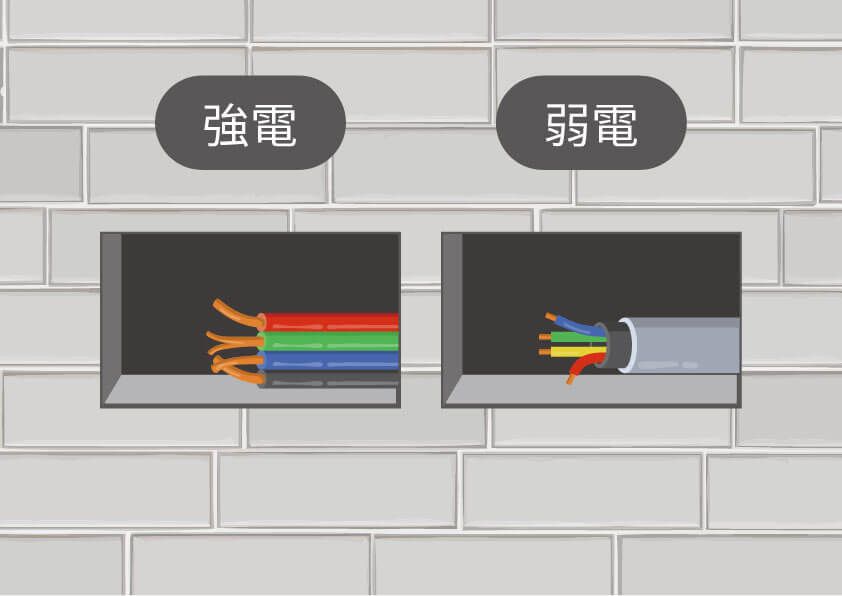
What is the difference between strong and weak current?
High-voltage electricity is characterized by high voltage, high current, high power, and low frequency, with the primary considerations being loss reduction and efficiency improvement
。
Generally refers to power supply and distribution systems such as utility power and lighting systems, including air conditioning lines, lighting lines, outlet lines, power lines, high-voltage lines, etc.
Weak current (ELV) is characterized by low voltage, low current, low power, and high frequency. The primary consideration is the effectiveness of information transmission, such as fidelity, speed, breadth, and reliability. Generally, it is divided into two categories: One is low-voltage electrical energy, such as safety voltage levels and control voltages regulated by the state, which can be AC or DC, such as a 24V DC control power supply or backup power for emergency lighting. The other is information sources carrying voice, images, data, etc., such as audio, video, network, and telephone lines, with DC voltage generally within 36V. Electrical appliances such as telephones, computers, TV signal inputs (cable TV lines), audio equipment (output lines), public address systems, and building automation controls (such as access control and security) in household appliances are all weak current (ELV) equipment.
The differences between strong current and weak current are roughly as follows: (1) Different AC frequencies
The frequency of strong current is generally 50Hz (Hertz), called "utility frequency," meaning the frequency of industrial electricity; the frequency of weak current is often high frequency or ultra-high frequency, measured in KHz (kilohertz) and MHz (megahertz).
(2) Different transmission methods
High-voltage electricity is transmitted through power transmission system lines, while low-voltage transmission is divided into wired and wireless; radio waves transmit wireless signals.
(3) Different power, voltage, and current levels
High-voltage power is measured in KW (kilowatts) and MW (megawatts), voltage in V (volts) and KV (kilovolts), and current in A (amperes) and kA (kiloamperes); low-voltage power is measured in W (watts) and mW (milliwatts), voltage in V (volts) and mV (millivolts), and current in mA (milliamperes) and uA (microamperes), so its circuits can be composed of printed circuits or integrated circuits.
High-voltage audiovisual systems also include high-frequency (hundreds of kHz) and medium-frequency equipment, but with higher voltage and larger current. Due to the development of modern technology, low-voltage systems have penetrated into high-voltage fields, such as power electronic devices and wireless remote controls. However, these can only be regarded as the low-voltage control part within high-voltage systems, which is still different from the controlled high-voltage system itself.
Based on the fundamental principle that weak current transmits signals and strong current transmits electrical energy, we can easily distinguish between strong and weak currents. For example, although electric shavers, flashlights, and other devices only use two dry batteries (3V), we cannot classify them as weak current just because the voltage and current are small. This is because they transmit electrical energy rather than signals, so they should belong to the strong current category.
Based on the description above, the relationship among the four can be outlined as follows:
High voltage always includes strong current, but strong current does not necessarily belong to high voltage.
Low voltage definitely includes extra-low voltage, and extra-low voltage definitely belongs to low voltage.
Low voltage is not necessarily high power, and high power is not necessarily low voltage.
(The above is from KKNews 'Complete Guide to Strong Current Knowledge'
https://kknews.cc/zh-tw/home/4qzaeq.html )
After discussing so much about high-voltage and low-voltage electricity, violations of construction specifications and low-voltage construction plans are still frequently encountered in many project sites.
wiring methods. Some situations can be easily corrected with a little time, but others can be quite troublesome. In addition to disorganized system wiring, there are also severe cases of cutting corners or taking the easy way out. These defects are difficult to detect from the surface after construction and are only discovered after testing or actual use, and they may even cause equipment damage. These extra troubleshooting tasks and time could often be avoided if low-voltage engineers
Pay extra attention during construction to avoid electrical safety concerns.
Sharing a practical case study of a junior high school in the Northern District using the BXB ICP-5100 IP Multimedia AV Public Address System
ICP-5100 undertakes the school-wide daily routine scheduled bell broadcasting, silent text broadcasting, audio-visual message broadcasting, and daily voice broadcasting for various offices, while remotely controlling classroom audio-visual display equipment (TVs) via network connection. In ICP-5131, one channel is for digital TV live broadcasting, three channels are for live broadcasting of DVD audio-visual content (used for English listening broadcasting), and three live broadcasting station channels (live broadcasting of on-site audio-visual messages). With this multi-combination program source format, BXB Electronics was selected as the best solution for the school.
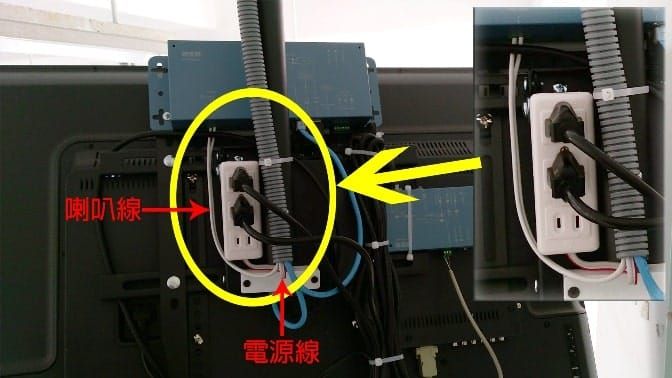
This site has a total of 19 classrooms and 19 LCD TVs. In addition to transmitting AV signals to the TVs, display device control is also required. Therefore, during construction, the ICP-5111 decoder and ICP-TV1 TV power control box were installed on the TV mounts. Under such requirements, the AC 110V power supply had to be reconfigured to power the equipment. The ICP-5111 decoder features a Class-D amplifier board, which can be directly connected to 8-ohm speakers for audio output. Precisely because both AC 110V power lines and speaker cables were required, engineering personnel overlooked several important precautions in wiring planning during construction. Below is a brief summary of these points:
1. Unclear distinction between high-voltage and low-voltage wiring (both use parallel flexible wires without color-coded wiring).
2. High and low voltage wiring are not isolated, arranged closely together and sharing the same conduit (lacking separation and routing design).
3. The ends of high and low voltage cables are not clearly labeled (both cables look identical, making them indistinguishable).
Figure: Actual wiring configuration at the site, where both speaker cables and power cords use parallel flexible wires, causing wiring issues.
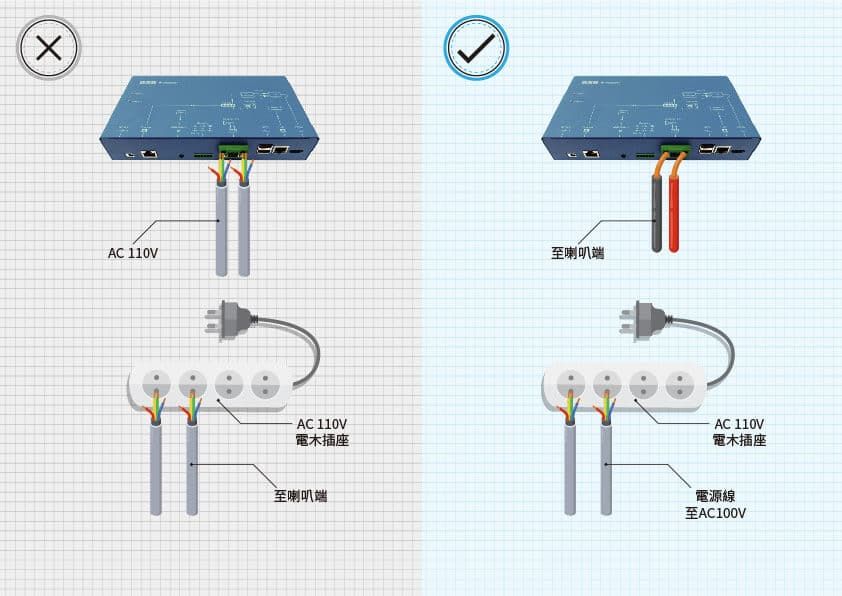
In the three points mentioned above, the construction method for the 19 classrooms was identical. Due to the failure to reconfirm the situation before the final power-on test and the failure to implement construction specifications, the AC 110V power cable was mistakenly connected to the decoder's speaker output port. This caused the AC 110V voltage to be directly conducted into the Class-D board inside the decoder, burning out and puncturing the IC chips of the two decoders.
In response to the aforementioned construction defects and wiring issues, we provide the following recommended wiring layout methods for on-site installers:
1. Use different cables for color coding:
Using one type of cable for speakers and another for power makes it easier to distinguish and less confusing.
2. Make clear markings:
Clearly mark both ends of the configured cables with label ties or similar to facilitate clear identification by construction personnel.
3. Circuit Separation or Branching:
High and low voltage wiring run along independent routes and do not share the same conduit.
Summary: We hope to provide substantial help and safety awareness to construction personnel and improve construction quality. After all, electricity usage is one of the most common items encountered during construction. Therefore, every detail should be understood more thoroughly, as prevention is better than cure.
#LowVoltageEngineering #LowVoltageEngineer #LowVoltageSystem #LowVoltageConstructionPlan #RecommendedUsageOfHighAndLowVoltage #DifferenceBetweenHighAndLowVoltage #ClassificationOfLowVoltage #AudioVisualEngineering