Buying Guide・2021-08-10
PA System: How to effectively configure amplifiers and speakers?
Industry Insights
In sound reinforcement systems, Hi-Fi audio or home theaters are more widely known. In contrast, as low-voltage engineering for public address systems, fewer people understand it, and many have misconceptions about the two. Due to their fundamental differences, how to effectively configure amplifiers and speakers in different application scenarios is a frequently asked question.
Therefore, from the perspective of commercial audio systems, this article discusses public address systems (PA systems) used in office buildings, schools, stations, shopping malls, factories, and other venues. We will explore this topic from the following three directions: power output forms and types of amplifiers, how to distinguish between constant-impedance and constant-voltage speakers, and how to pair amplifiers with speakers. Welcome to read [
What is a PA System? Digital Public Address Benefits and Equipment Selection Guide
] Choose the right equipment based on the venue's needs.
Understanding the two major power output types of amplifiers
Low-impedance system:
Constant-resistance amplifiers, also known as low-impedance systems, use low-voltage, high-current output. Due to the high current, professional audio cables must be selected; and since the load resistance is fixed, the speakers must match the output impedance of the amplifier. Low-impedance systems are mostly used in home theaters, conference rooms, and other venues where the speakers are close to the amplifier and do not require connecting many speakers. Additionally, these scenarios have higher requirements for sound quality, demanding better sound clarity and richness.
High-impedance system:
Constant-voltage amplifiers, also known as high-impedance 100V / 70V Line systems, utilize high-voltage, low-current output, resulting in lower line loss and allowing for relatively longer distances between public address speakers and the amplifier. Speakers are connected in parallel, allowing multiple speakers to be connected, provided that the total power does not exceed the total power capacity of the constant-voltage amplifier. Because constant-voltage systems use transformers in their circuitry, sound quality is affected and is not as good as constant-resistance systems. Therefore, they are more suitable for environments where sound quality requirements are not extremely high and the primary purpose is voice amplification. They are commonly used in public address systems for public spaces, such as shopping malls, stations, background music in office buildings, and school public address systems.
Comparing constant impedance and constant voltage systems: advantages of excellent sound quality and effects vs. simple system impedance matching and high scalability.
Long transmission distance, low line loss, low cost, and disadvantages
Speaker and amplifier impedance must match; scalability is limited and requires professional audio cables. The cost is high, and the sound quality is slightly inferior to constant-impedance signals. Applicable venues
Scenarios with small areas but high demands on sound quality, such as: conference rooms, home theaters, stages, etc.
Suitable for long-distance public address systems, such as: campuses, factories, stations, shopping malls, etc.
What types of amplifiers are there? How to choose?
The working principle of an amplifier is to amplify various audio signals to drive speakers to produce sound. From a technical perspective, an amplifier converts alternating current (AC) into direct current (DC), and then, based on the audio signal, transmits currents of different magnitudes at different frequencies to the speakers for sound reinforcement. Considering power, impedance, distortion, dynamics, different usage ranges, control and adjustment functions, product positioning, and application scenarios, there are three types of amplifiers: preamplifiers, pure power amplifiers, and integrated amplifiers.
Pre-amplifier (Pre-amplifier
): also known as a preamplifier, connected between the audio source and the power amplifier. Its main purpose is to amplify voltage, serving to amplify signals, provide appropriate audio level signals, and adjust sound quality, playing an important role in affecting the timbre in a sound reinforcement system.
Power amplifier: Also known as a pure power amplifier. It is connected before the speakers, and its main purpose is to amplify audio signals to provide sufficient power to drive the speakers to produce sound. Generally speaking, 'amplifier' refers to a pure power amplifier.
Mixer amplifier: Also known as an integrated amplifier, it combines the circuitry of a pre-amplifier and a power amplifier into a single unit. Its function is the combination of both or with more features added, such as independent volume control or EQ IN/EQ OUT ports, allowing for advanced applications like connecting external professional mixers or digital audio processors.
In commercial public address systems, efficient message transmission and cost-effectiveness are emphasized, making power amplifiers or integrated amplifiers more common. For example, in large venues such as office buildings, campuses, or shopping mall broadcasting, choosing a power amplifier is more suitable; in churches, conference rooms, lecture halls, etc., an integrated amplifier is preferred.
How to distinguish between constant-voltage speakers and constant-impedance speakers?
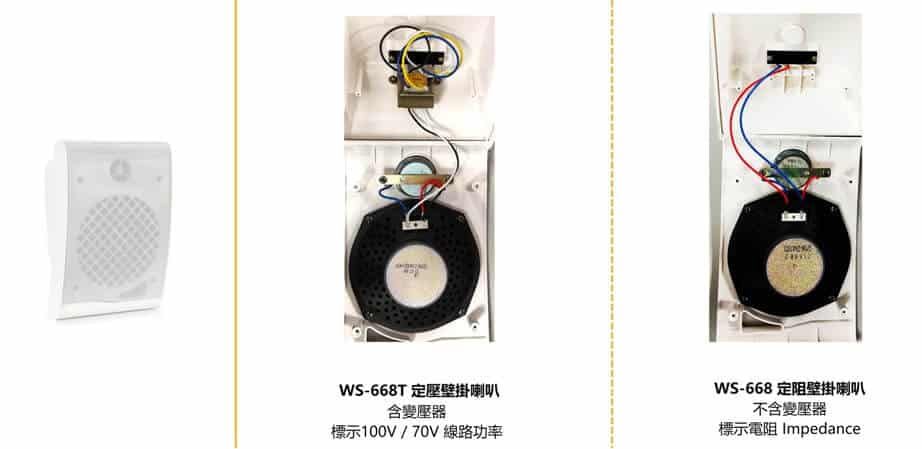
This is usually indicated on the speaker's product label, or you can open the speaker's back cover. Constant-voltage speakers have a transformer, while constant-resistance speakers do not. Constant-voltage speakers are more commonly found in commercial public address systems for campuses, shopping malls, and similar scenarios, whereas constant-resistance speakers are typically used in home theaters, conference rooms, and other similar environments.
BXB WS-668 / WS-668T Constant Voltage / Constant Impedance Wall-Mount Speaker
Basic principles for choosing constant-voltage or constant-impedance speakers: In application scenarios with long wiring distances or large areas, a large number of speakers, and where the sound quality requirement is primarily clear message transmission, choose constant-voltage speakers. In application scenarios with shorter wiring distances, usually within 10 meters, fewer than 4 speakers, and high requirements for sound quality and sound effects, choose constant-impedance speakers.
How to Match Amplifiers and Speakers?
Choosing between a constant voltage or constant impedance system mainly depends on the venue, environment, and the desired effect.
Generally speaking, constant-voltage amplifiers are connected to constant-voltage speakers, and constant-impedance amplifiers are connected to constant-impedance speakers. In meeting rooms or home theater application scenarios, constant-impedance systems are mostly used to pursue sound quality; in large-scale commercial applications, constant-voltage systems are commonly used to achieve higher cost-effectiveness.
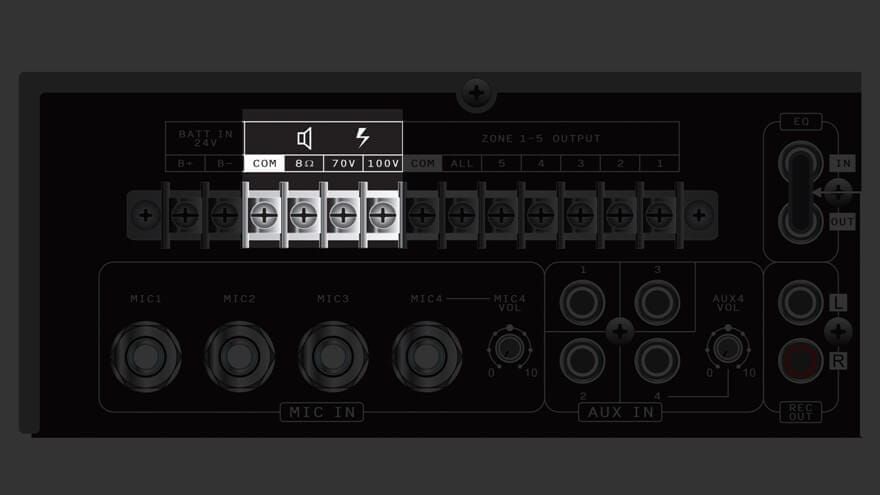
With continuous technological progress, many public address system amplifiers are equipped with both constant-voltage and constant-impedance ports, allowing them to connect to both constant-voltage and constant-impedance lines simultaneously. A single amplifier can meet the diverse application needs of conference rooms or campuses, making it a better choice when building a public address system (Recommended: Amplifier Series)
。
BXB
PA-5120P1 120W Integrated Amplifier, providing both constant impedance and constant voltage outputs. More Amplifier & Speaker Q&A
Can a constant-voltage amplifier be connected to constant-impedance speakers?
Amplifiers and speakers cannot be mixed and matched; constant-voltage amplifiers must be connected to constant-voltage speakers, and constant-impedance amplifiers to constant-impedance speakers. If the voltage signal output from a constant-voltage amplifier is connected to a constant-impedance speaker, there is a risk of burning out the speaker when the power is too high. Additionally, when connecting constant-impedance speakers to an amplifier, it is crucial to ensure that the amplifier's impedance matches; otherwise, there is also a risk of burning out the speakers.
How to connect the 100V and 70V lines of a constant-voltage amplifier?
When connecting a constant-voltage speaker to an amplifier, there are three ports: 100V, 70V, and COM. Pay attention to the connected ports. When a 10W speaker is connected to the 100V and COM ports, the speaker will operate at its rated power of 10W. However, if the 10W speaker is connected to the 70V line, because the power difference between 100V and 70V is twofold, the speaker will operate at 5W, and the volume will be lower.
How are speakers applied in various scenarios?
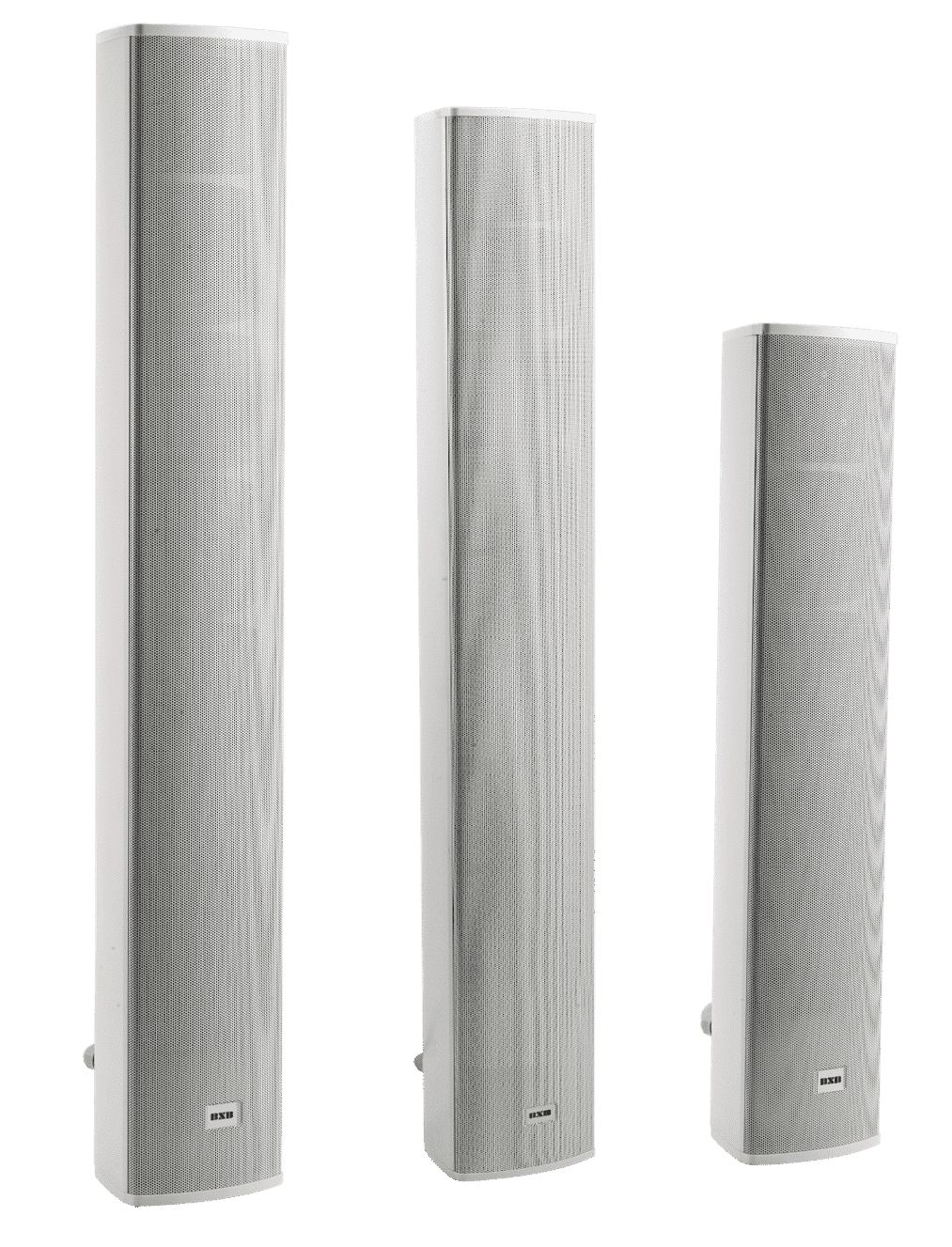
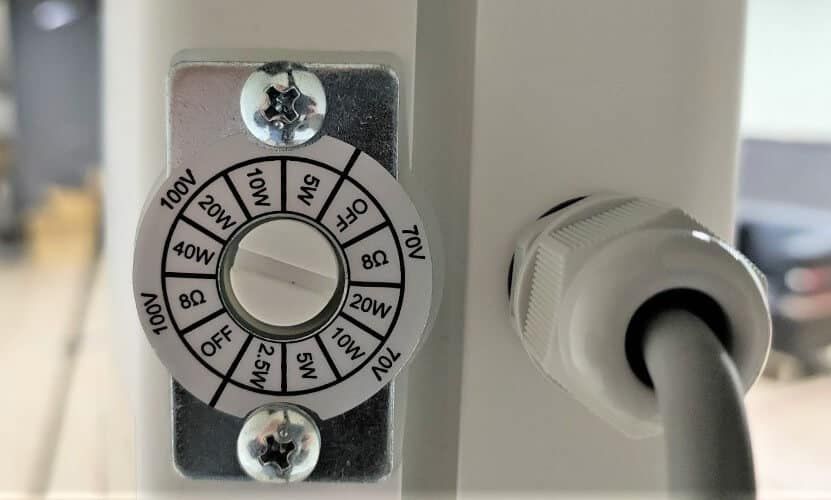
Due to the diversity of commercial scenarios, you can choose speakers with a "power selection knob" to adapt to various needs. For example, BXB's WS-8140 column speaker features a "power selection knob." In outdoor or semi-outdoor areas like covered sports courts, it can be switched to high power; indoors, such as in conference halls, it can be switched to 6 / 8 ohm low impedance, making system integration more flexible.
BXB
WS-8140 Adjustable Waterproof Column Speaker and Power Selector Switch
BXB Electronics has focused on commercial PA systems for 30 years, providing complete product solutions including microphones, zoned broadcasting, public address, amplifiers, and speakers to meet the diverse application needs of classrooms, campuses, stadiums, shopping malls, factories, and office buildings. BXB has agent and dealer channels in more than 50 countries worldwide. Welcome to contact us through the form below.