Buying Guide・2019-07-08
AV over IP - The Future of Professional AV Integration You Must Know!|BXB Electronics
Industry Insights
The Rapid Growth of AV over IP: Why Has It Been So Popular in Recent Years?
AV over IP has been in the Professional Audiovisual (ProAV) integration market for several years, and has become particularly hot in the last two years. With triple-digit growth for two consecutive years in 2017 and 2018, it has caught the attention of everyone in the ProAV industry. It has been the most eye-catching focus at major professional exhibitions worldwide, including Integrated Systems Europe (ISE) and InfoComm, the world's largest professional audiovisual equipment exhibition. Many foreign industry professionals have stated that AV over IP has become the future trend of the ProAV industry, and is expected to achieve astonishing rapid growth at a compound annual growth rate of 60% over the next five years starting from 2019.
However, what is AV over IP? Why has AV over IP grown so rapidly in recent years?
What is AV over IP?
AV over IP (Audiovisual over Internet Protocol), also known as AV/IP, AV over Network, or IP distributed AV system
, network audio and video transmission systems, etc. AV over IP is an internet protocol-based audio and video transmission technology, which can also be described as the IoT concept in the IT industry. In the ProAV professional audio-visual integration industry, it is commonly referred to as AV over IP. In terms of technical essence, it transmits audio and video data through standard networks, such as LAN, WAN, or the internet cloud. In fact, it is similar to the concept of Netflix internet TV at home. With the popularization of IoT applications in various industries, AV over IP has begun to be widely used to replace traditional AV architectures.
This article introduces the technology and advantages of AV over IP in a conceptual and easy-to-understand manner, while the relevant technical specifications and implementation considerations will be introduced in detail in subsequent chapters.
What is the difference between traditional AV architecture and AV over IP?
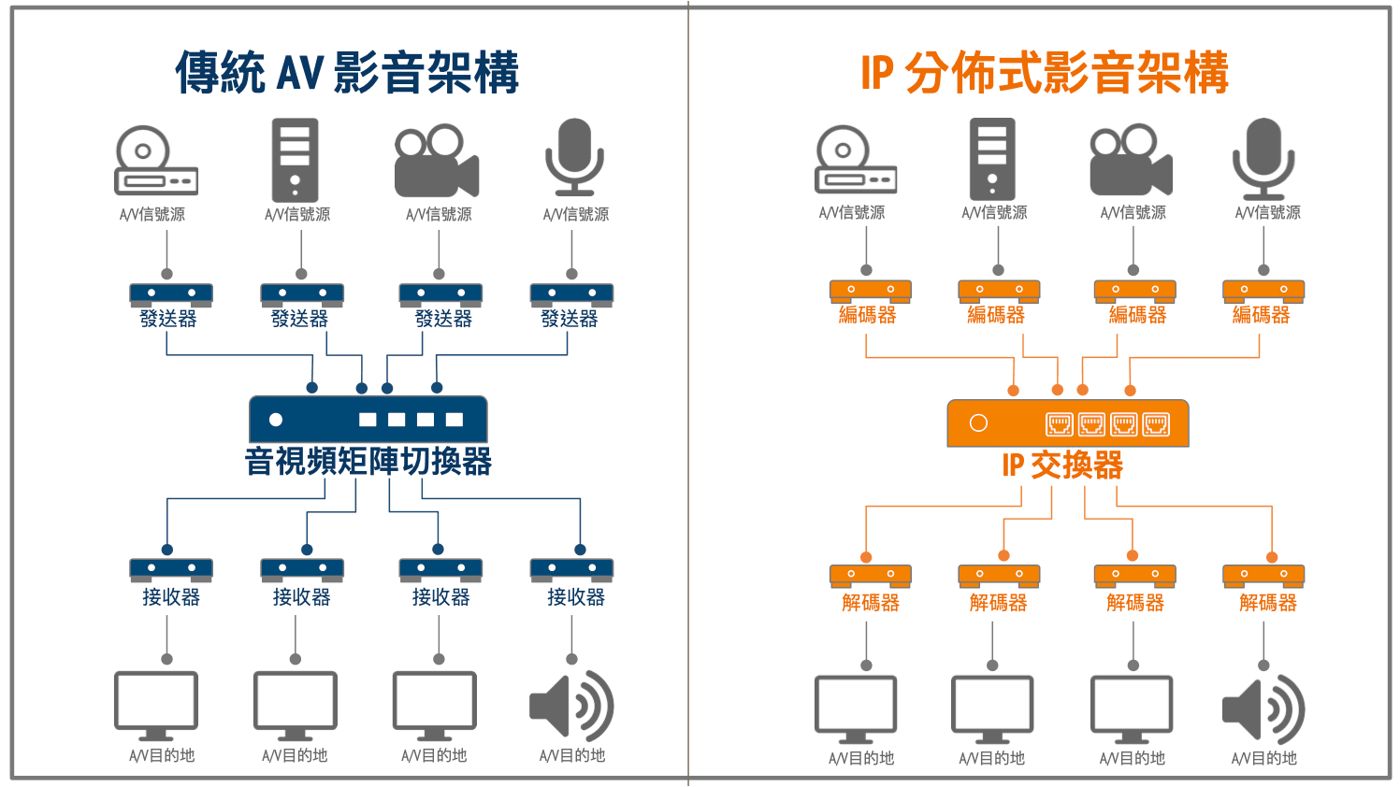
The basic elements and main architectures of traditional AV and AV over IP are quite similar. From a simple architecture diagram, IP replaces the traditional AV audio/video transmitter (Tx) with an encoder, and the receiver (Rx) with a decoder; the audio/video matrix switcher is replaced by a standard Ethernet IP network switch. The IP switch is identical to the switches currently used in enterprises; as long as there is a network in your environment, there will definitely be an IP switch.
Although both architectures look similar, there are three main differences in their technical essence.
Transmission line:
Traditional AV architecture uses "physical cabling" for transmission. No matter how they are daisy-chained, and regardless of the signal type—whether analog signals like S-Video and composite, or digital signals like HDMI, HDBaseT, and SDI—they are all transmitted through physical cables and AV matrix switchers, forming a series of boxes. On the other hand, IP-based transmission connects using commonly used Cat5e or Cat6 network cables with IP switches, transmitting via Ethernet, WAN, LAN, or wireless networks.
Data format:
Traditional AV architecture preserves the data completely from the AV source without data compression or segmentation, transmitting it to the AV destination device via physical cables and a series of boxes. In contrast, AV over IP encodes the data from the AV source into network packets using an encoder for transmission. Each packet contains a portion of the original data, a destination, and a sequence. Through an IP switch, packets are sent according to their destination addresses. After receiving the packets, the decoder decodes them back into a data format acceptable by the AV destination for playback or data control.
Switching method:
In traditional AV architectures, audio and video matrix switchers play a crucial role as hubs that transmit signals from sources to designated destinations. Except for a few models that can be expanded using hardware cards, most matrix switchers have a fixed number of ports, categorized into input and output ports. Common configurations include 4x4, 8x8, 16x16, or 64x64 matrix switchers, which utilize pure hardware for point-to-point transmission. Taking a 4x4 (4-in, 4-out) matrix switcher as an example, it can transmit and switch 4 AV source signals to any of the 4 destination devices for display or playback. In contrast, AV over IP operates by assigning an IP address to every endpoint. Data is transmitted in packets to an IP switch and then forwarded to the destination. Switching is performed via software by specifying the source and destination IP addresses. Since the ports of an IP switch can connect to multiple IP switches for expansion, the number of source and destination endpoint devices is no longer limited by the port capacity of a physical matrix switcher, allowing for arbitrary expansion and adjustment of endpoint devices.
Based on the introduction of the three fundamental differences above, we can understand that AV over IP is an audio-visual signal transmission technology developed with IoT protocols and IT networks as its core concepts. What benefits does this technology bring that differ from traditional AV?
Advantages and benefits of AV over IP - breaking transmission distance limitations:
Due to the limitation of requiring physical cables for transmission, long-distance transmission is a major drawback of traditional AV architecture. In the past, for small-scale projects, a distance of tens of meters could be resolved by running cables. Although AV signal cables are more expensive than network cables, the cost was still acceptable. However, when the project scale is larger and the transmission distance exceeds 100 meters, the cost and wiring labor increase significantly. After transitioning to IP, AV signals are transmitted via low-cost Cat5e or Cat6 network cables and connected through IP switches, making transmission over hundreds of meters no longer an issue. Furthermore, with IP integration, all AV signals can connect to the cloud via the network, making the management of remote AV equipment effortless.
High scalability:
When building an AV system, scalability is one of the key evaluation points. Since traditional AV architecture is limited by the number of input/output ports of audio and video matrix switchers, and most projects, due to budget considerations, only purchase equipment for the number of endpoint devices needed at the time of construction. Once the AV system is installed, there is a lack of flexibility if there are expansion or modification needs for future business applications. For simpler projects, additional matrix switchers need to be purchased, and physical lines need to be rearranged or adjusted, resulting in a significant increase in cost and labor. For more complex projects, it usually requires building another system or starting completely from scratch. Conversely, IP-based distributed systems bring high scalability. In addition to the aforementioned advantages that IP switches can be cascaded for expansion and the number of endpoint devices can be adjusted arbitrarily, they can also provide end-users with a budget-friendly solution when building AV systems. For example, if an end-user only has an audio budget in the first year, they can build the audio equipment first, and when they have a video budget, they can build the video on the same IP distributed AV system.
More Cost-Effective Solutions:
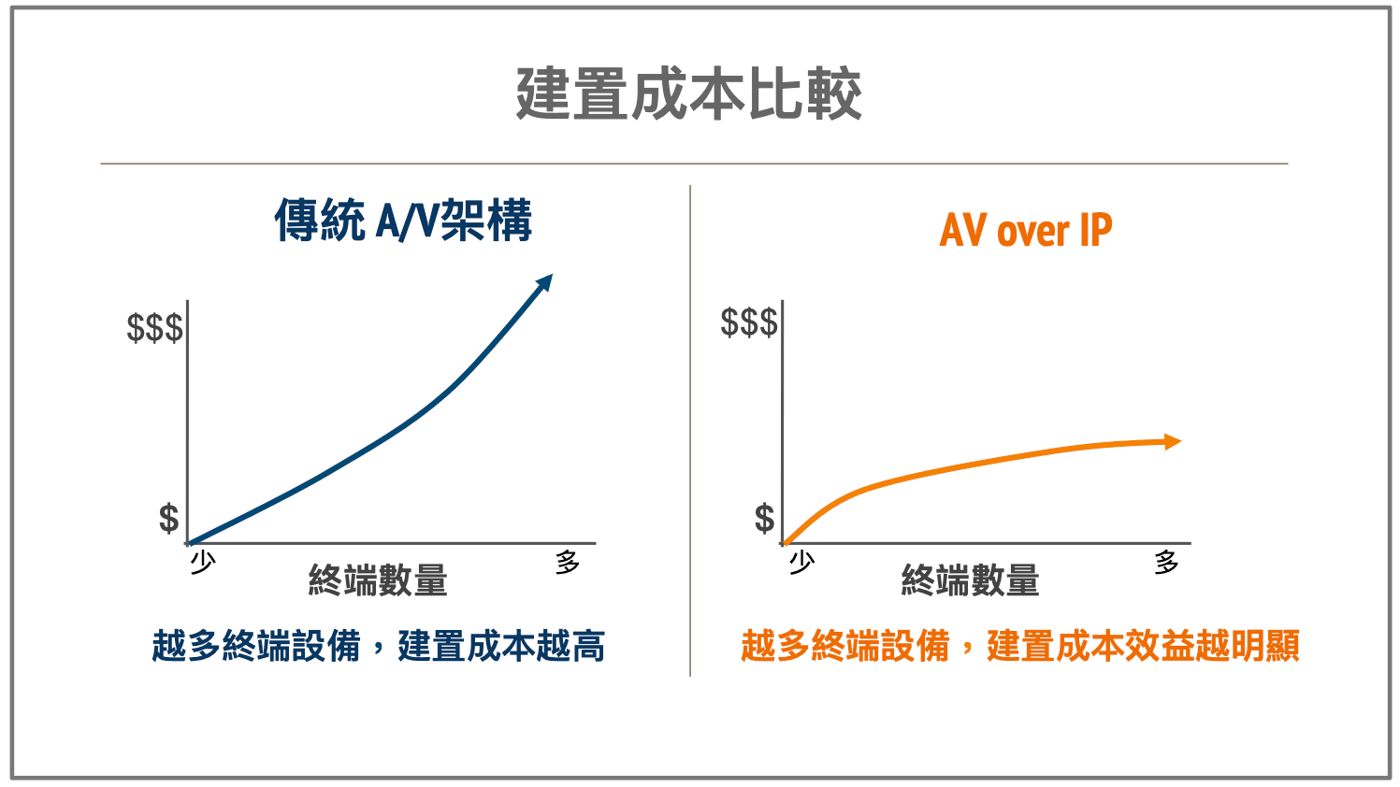
A major feature of the IP distributed AV system architecture is the use of existing IT network infrastructure to save deployment costs. The greater advantage of IP-based systems in terms of cost savings is: "The more you use, the more you save." When there are more terminal devices, traditional AV architectures require more input and output ports on the audio-video matrix switcher, which increases the cost of the matrix switcher. Conversely, the high scalability of IP switches is inexpensive and convenient. As the number of terminal devices increases, the cost-effectiveness of the entire AV system deployment becomes more pronounced.
This year, there was a massive overseas project with 800 endpoint devices installed. The cost of using the IP distributed AV system architecture was a full 1 million USD (nearly 30 million TWD) cheaper compared to traditional AV system audio-video matrix switchers!
The major trend of AV over IP is coming soon
In his 2019 "Friends of Time" New Year's Eve speech, Luo Zhenyu mentioned that a trend change in one industry is often triggered by an impact from another. AV over IP is a prime example. Originating from the IT industry, it has brought a massive impact across various sectors with the development of IoT internet technology. Now, it has also impacted the entire professional AV integration industry, blurring the lines between AV and IT, and is likely to completely revolutionize the entire ProAV industry in the coming years.
From the perspective of technological development, IP-based transition in the AV industry has just begun. The minor trend is set, and the major trend is highly anticipated! As professionals in the industry, you must be aware of this; do not wait until the minor trend becomes a major trend to regret not keeping up.
In the future, any organization will inevitably embrace AIoT (AI + IoT). IP-based transition is the IoT infrastructure for audio and video. To utilize audio and video as organizational assets that foster creativity and productivity, a highly scalable, cost-effective AV system solution that breaks through distance limitations is essential.
This article introduces the technology and advantages of AV over IP in a conceptual way. If you found it helpful or inspiring, please feel free to share it with more friends. In the future, we will introduce AV over IP related technologies, implementation evaluation methods, and related case applications. Please stay tuned for the latest updates from BXB Electronics!
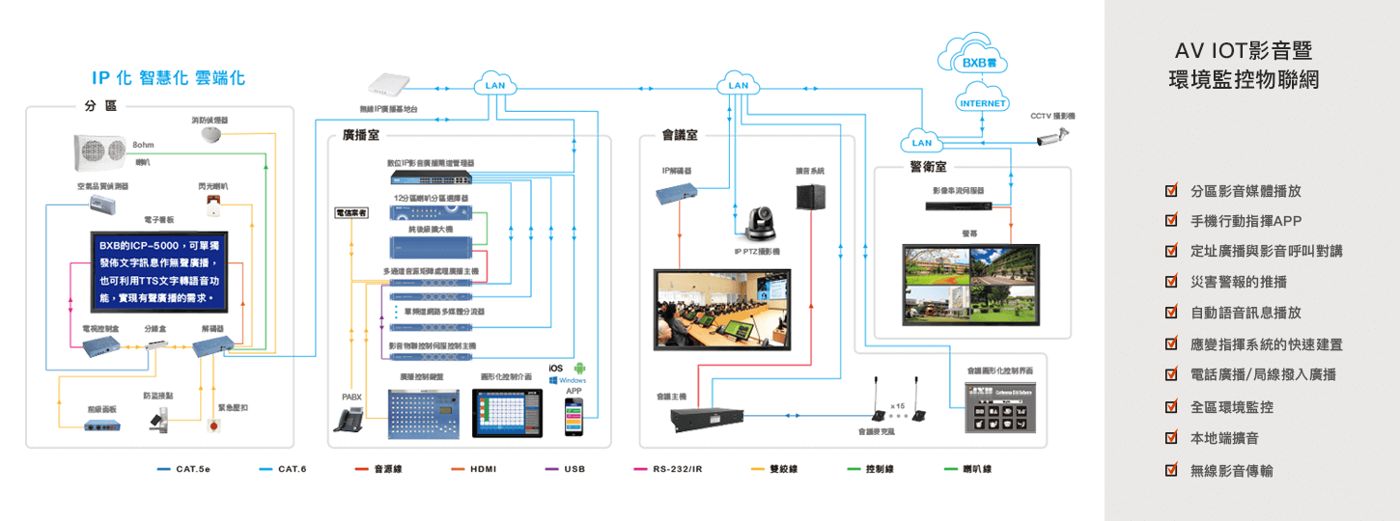
BXB's ICP-5100 Multimedia Publishing System applies AV over IP technology
Learn about the product features of the ICP-5100 Multimedia Information Distribution System