Buying Guide・2021-01-05
Conference Microphone Tips and Tricks Revealed |BXB Electronics

Industry Insights
For a conference system, how many microphones are enough?
In the procurement of conference systems, the number of active conference microphones is often used as a hard indicator for evaluation, and most people believe that the more, the better! However, to obtain good conference sound quality, the most important thing is to configure the microphone positions and the number of active microphones in the conference system. These are issues we need to look at scientifically and rationally.
In fact, the fewer conference microphones turned on simultaneously, the better!
As the entry point for audio pickup, conference microphones not only capture the speaker's voice but also pick up unnecessary surrounding 'noise', which is simultaneously amplified in the circuitry! The more microphones that are turned on, the lower the gain before feedback becomes. This reduction value decreases by 3dB as the number of microphones increases exponentially! Below is a simple summary table of the differences: Number of Microphones: 1 | 2 | 4 | 8 | 16 / Gain Before Feedback Weighting: 0 | -3 | -6 | -9 | -12
We can see that when the number of simultaneously active microphones reaches 8, there is a 9dB drop. This means that our sound system, which could originally have been set to a very comfortable listening level of 88dB, must be reduced to an insufficiently loud 79dB just because 8 microphones are open at the same time, and even more unnecessary noise is mixed in during this process.
Comb Filtering Effect of Conference Microphones
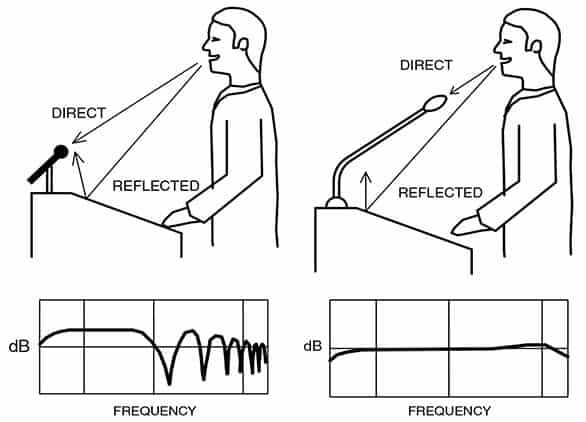
When there is a distance difference from the sound source to the microphones, and the signals enter a sound reinforcement system at the same time, a comb filtering effect will occur.
If a single sound enters two different microphones, there will also be a distance difference, which will cause a comb filtering effect.
The key to both of the above situations lies in 'the distance from the sound source to the microphone'
...there is a second sound, resulting in a path difference. This comb filtering effect manifests in sound quality as the loss of certain frequencies, making the frequency response look like the teeth of a comb. In a conference system, although speakers rarely have two microphone capsules at the same time, their voice might be picked up by other microphone units due to re-amplification by the PA system, unintentionally causing a comb filtering effect.
Image source:
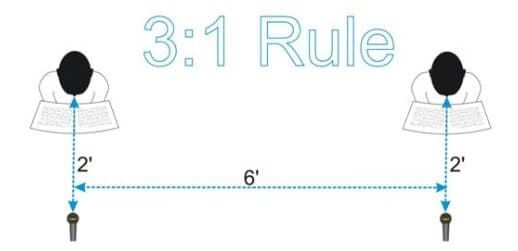
http://www.avnetwork.com/portals/0/AVT_03_13_Final-55.jpg3:1 Rule
Therefore, in live sound reinforcement, there is an unwritten rule of thumb. If the distance from the sound source to the microphone is 1, then the distance between the microphones should be 3. By utilizing this distance difference to attenuate sound energy, we can avoid the pulling and cancellation of sound energy between microphones. Imagine a press conference where all the microphones of the seated delegates are turned on. When a speaker talks close to a microphone, the sound is full. However, once they move away, the sound becomes hollow and is picked up by different microphones, causing cancellation! Image source:
http://www3.telus.net/Whalco/AudioPhase/image016.jpg
If you can't stay away, then get extremely close!
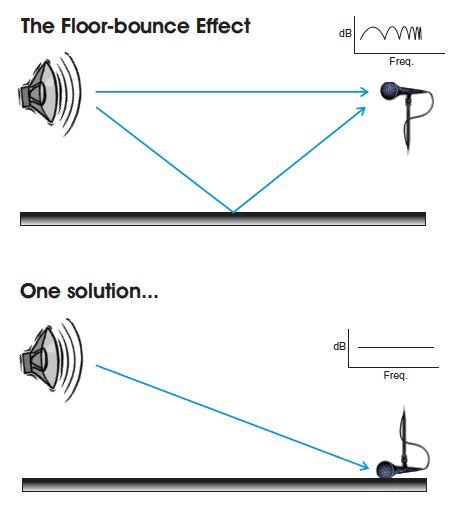
Regarding these two issues, there are two typical approaches for reference. One type of microphone is called a flat or boundary microphone (Boundary Microphone), which is "extremely close"
typical example. Placing the microphone on a flat surface makes the reflection path almost equal to the incident path, so that the 'path difference' of the comb filtering effect
The prerequisite key disappears! Image source:
http://www.prosoundtraining.com/site/wp-content/uploads/2010/02/The_Floor-Bounce_Effect-fig2.png
Another typical setup is placing the capsules of two conference microphones extremely close to each other. As shown in the speech by the current President of the Republic of China (Taiwan), Tsai Ing-wen, below, this is the official standard setup for audio pickup microphones. You can see that these conference microphones are extremely close together, rather than being placed separately on both sides of the lectern, which is a setup that perfectly aligns with physical principles. Unfortunately, this type of setup is not feasible in general meeting and discussion scenarios; however, it is still worth learning about and understanding! Image source:
http://hk.dailyeconomic.com/wp-content/uploads/2016/01/cai1.jpg
The Invisible Helper for Auto-Switching Microphones - "Noise Gate"
The methods mentioned above are treatments based on the 'spatial domain.' Can we address this in the 'time domain'? Similar technology has already been applied to live sound reinforcement. If a mixer is used, sound engineers can usually control each microphone individually! They would add noise gate equipment as an auxiliary option for auto on/off (automatic opening/closing) of the microphones, making the microphones appear active, but actually configured on the mixing console to open only when spoken into,
a paused or temporarily closed state.
Image source:
http://sound.eti.pg.gda.pl/denoise/img/noisegate01.gif
This microphone management technique works wonders in live performances, turning off unused microphones to reduce crosstalk between them, thereby improving clarity.
Speaking close to the microphone provides clear direct sound and reduces background noise.
Natural sound energy is a point source and follows the inverse-square law; for every doubling of distance, the sound attenuates by 6dB. In other words, for every halving of distance, the sound increases by 6dB. Therefore, it is generally recommended to use the microphone at a distance of 3 to 5 cm.
We can see from the table below the gain value drop at a certain distance from the microphone capsule, using 5 cm as the standard: Distance (cm)2.535810152030Acoustic Energy Weighting (dB)6.04.40.0-4.1-6.0-9.5-12.0-15.6
From this table, we can see that when a speaker moves away from the microphone, a significant amount of sound energy is lost. Conversely, staying close to the microphone not only captures better sound but also significantly increases the "ratio" of voice to background noise, making it less susceptible to background interference! Therefore, looking globally, great leaders practice using microphones effectively, leveraging speech and sound reinforcement systems to boost team morale!
Live sound reinforcement systems are not omnipotent; there is a limit to acoustic feedback gain, requiring joint efforts from users!
Every sound system has its limits, which are determined by speaker sensitivity, power handling, and the relative positions of the microphone and speaker. In venues where microphones and speakers coexist, it is absolutely impossible to endlessly push the overall system gain; it must be built up detail by detail. The details mentioned above can all cause a reduction of dozens of dB. This is not a problem that can be solved purely by technology; it requires all end-users to cultivate correct habits so that all participants can receive the best listening quality.
After reading this article, here are a few actions you can take
Changing the settings of the conference system main unit to reduce the number of active speaking microphones to 2 or 3 (excluding the chairman) makes this quantity very suitable for discussions led by both parties and the chairman. You can share and forward this to your supervisor because:
"A good leader will make good use of the advantage of speaking close to the microphone"
。
Appropriately review the desktop layout of the meeting room to see if it meets ergonomic standards. Can participants reasonably approach the microphone? Does the distance between the microphone and the speaker comply with the 3:1 ratio?
Consider providing pads or felt on the conference room table to reduce tabletop sound reflections.
#MicrophoneTechniques #MicrophoneDistance #ConferenceMicrophone #ConferenceSystem #CombFilterEffect #NoiseGate #AudioSystem #PowerAmplifier